Semiconductor manufacturing is one of the most contamination-sensitive industrial processes in the world.As device geometries shrink to the nanometer scale,even the slightest chemical imbalance in the cleanroom environment can affect yield,reliability,and long-term device performance.This is why the AMC Filter has become a core component in semiconductor fabs,where controlling airborne molecular contaminants is just as critical as controlling particles.
In semiconductor fabrication facilities,airborne molecular contaminants originate from a wide range of sources.These include process chemicals,exhaust backflow,building materials,outdoor air intake,and human activity.Common AMC species found in fabs include acidic gases,basic compounds,dopants,and organic vapors.Unlike particles,these molecular contaminants can easily penetrate conventional HEPA filtration and directly interfere with wafer processing steps.
One of the most important applications of AMC Filters in semiconductor manufacturing is corrosion control.Advanced fabs contain a large amount of sensitive metal components,including copper interconnects,aluminum structures,and precision sensors.Acidic AMCs such as sulfur compounds and nitrogen oxides can cause micro-corrosion on metal surfaces,leading to electrical failures and tool instability.By installing AMC Filters in air handling systems,these corrosive gases are adsorbed before they reach critical areas.
Lithography processes are particularly vulnerable to airborne molecular contamination.Photoresists and chemically amplified resists are highly sensitive to basic contaminants such as ammonia and amines.Even extremely low concentrations can result in linewidth variations,pattern collapse,or critical dimension shifts.AMC Filters designed to target basic contaminants play a crucial role in maintaining stable lithography performance and ensuring consistent pattern fidelity.
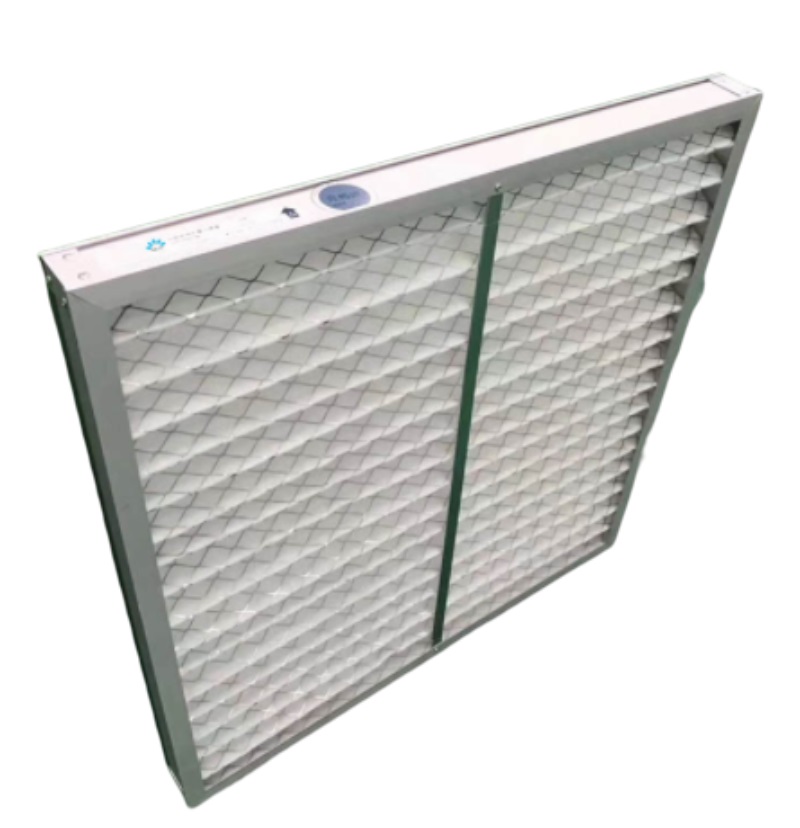
Etching and deposition processes also benefit significantly from AMC filtration.During plasma etching or chemical vapor deposition,surface reactions must occur under tightly controlled conditions.Organic vapors or dopant-related AMCs can alter reaction kinetics,leading to non-uniform films or unwanted residues.An AMC filter helps maintain a clean chemical background,allowing these processes to operate within their designed parameters.
In advanced semiconductor fabs,AMC filters are commonly used in both makeup air systems and recirculation loops.Treating makeup air prevents outdoor molecular contaminants from entering the fab,while recirculation filtration continuously removes internally generated AMCs.This dual approach is essential for maintaining ultra-low contamination levels throughout long production cycles.
Yield improvement is one of the most measurable benefits of using AMC filters in semiconductor manufacturing.Molecular contamination-related defects are often difficult to detect and diagnose,yet they can significantly impact final device performance.By reducing the presence of harmful AMCs,an AMC filter helps fabs achieve higher yields,lower scrap rates,and more predictable production outcomes.
Another key application of AMC filters is in protecting advanced nodes and next-generation technologies.As fabs transition to smaller process nodes and more complex architectures,sensitivity to chemical contamination increases dramatically.AMC control becomes a foundational requirement rather than an enhancement.Many leading fabs now specify AMC filtration as part of their base cleanroom design.
From a cost perspective,AMC filters represent a relatively small investment compared to the potential losses caused by contamination-related failures.Equipment downtime,yield loss,and product recalls can far exceed the cost of implementing proper AMC filtration.As a result,semiconductor manufacturers increasingly view AMC filters as a risk mitigation tool rather than a discretionary expense.
Customization is also an important aspect of AMC filter applications in semiconductor fabs.Different process areas may require different filtration media depending on the dominant contaminants present.Modern AMC filter solutions can be tailored to target acids,bases,organics,or mixed AMC profiles,ensuring optimal performance for each application zone.
In summary,AMC filters play a vital role in semiconductor manufacturing by controlling airborne molecular contaminants that directly impact corrosion,lithography,etching,and yield.As device scaling continues and process complexity increases,the importance of AMC filtration will only grow.For semiconductor fabs aiming to achieve consistent quality,high yield,and long-term reliability,the AMC filter is an indispensable part of the cleanroom infrastructure.