In high-tech manufacturing environments such as semiconductor fabrication,pharmaceutical production,and advanced electronics assembly,controlling airborne particles alone is no longer sufficient.Molecular-level contamination,commonly referred to as AMC(Airborne Molecular Contamination),has become one of the most critical factors affecting product yield,reliability,and long-term performance.This is where an AMC HEPA fan filter plays a vital role in modern cleanroom systems.
Traditional HEPA Filters are designed primarily to capture solid particles such as dust,fibers,and microorganisms.While they are extremely effective at particle removal,they are not capable of addressing gaseous or molecular contaminants.An AMC HEPA fan filter,however,is engineered to handle both particulate and molecular contamination simultaneously,providing a more comprehensive air purification solution.
At its core,an AMC HEPA fan filter combines three essential elements into one integrated unit:a high-efficiency HEPA Filter,a chemical filtration media layer,and a fan-driven airflow system.Each of these components contributes to the removal of molecular contamination in a distinct yet complementary way.
Molecular contamination typically consists of acidic gases,basic gases,organic compounds,and dopant-related chemicals.These contaminants are often released from construction materials,process chemicals,human activity,or outgassing from equipment.Even at extremely low concentrations,they can cause corrosion,surface defects,photolithography errors,and chemical reactions on sensitive substrates.
The first stage of an AMC HEPA fan filter addresses particulate matter.Incoming air passes through a Hepa Filter rated at H13 or H14 efficiency,removing at least 99.95%to 99.995%of particles down to 0.3 microns.Although this stage does not directly remove molecular contaminants,it prevents particulate buildup on downstream chemical media,ensuring stable performance and extending the service life of the system.
The second and most critical stage is the chemical filtration layer.This is where molecular contamination is actively removed.AMC HEPA fan Filters typically use activated carbon,impregnated carbon,alumina,or proprietary chemical media designed to adsorb or chemically react with specific molecular contaminants.Acidic gases such as sulfur dioxide or nitrogen oxides are neutralized through chemical reactions,while organic vapors and solvent residues are captured through adsorption.
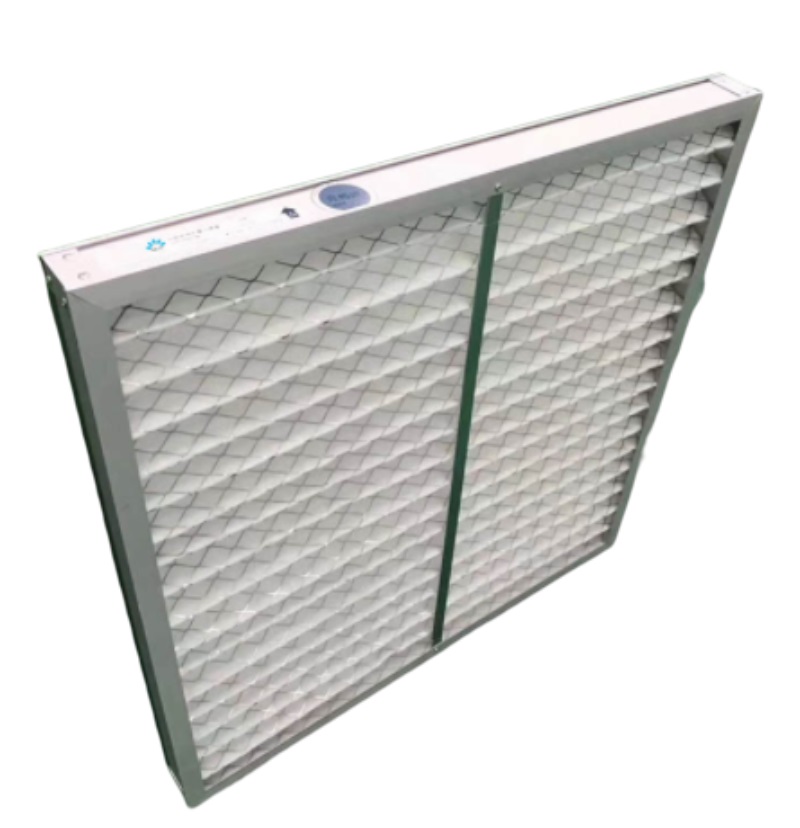
Unlike general carbon filters used in HVAC systems,the chemical media inside an AMC HEPA fan filter is carefully selected based on the contamination profile of the cleanroom.Semiconductor fabs,for example,often require media optimized for acidic and basic gases,while pharmaceutical environments may focus more on organic compounds.This customization capability is a key reason why AMC HEPA fan filters are widely adopted in advanced cleanroom designs.
The fan module integrated into the AMC HEPA fan filter ensures consistent airflow across the entire filter surface.Stable airflow is essential for molecular removal because adsorption efficiency depends on contact time between contaminated air and the chemical media.A well-designed fan system maintains uniform air velocity,minimizes turbulence,and prevents bypass leakage that could compromise filtration efficiency.
Another important factor in molecular contamination control is real-time performance stability.As chemical media becomes saturated over time,its adsorption capacity gradually decreases.High-quality AMC HEPA fan filters are designed with sufficient media depth and optimized airflow to maintain effective molecular removal throughout their service life.Many systems are also compatible with AMC monitoring solutions,allowing facilities to track contamination levels and plan filter replacement before performance degradation affects production.
One of the major advantages of using an AMC HEPA fan filter is localized contamination control.Instead of treating the entire cleanroom air volume through a central system,fan filter units can be installed directly above critical process areas.This localized approach reduces cross-contamination risks and provides faster response to contamination sources,which is particularly important in high-density manufacturing environments.
Energy efficiency is another consideration.While adding chemical filtration media increases airflow resistance,modern AMC HEPA fan filters are engineered to balance pressure drop and filtration performance.Advanced fan motors and aerodynamic designs help maintain low energy consumption without sacrificing molecular removal efficiency.
In summary,an AMC HEPA fan filter removes molecular contamination through a combination of high-efficiency particulate filtration,specialized chemical adsorption or reaction media,and controlled fan-driven airflow.This integrated design allows cleanrooms to address both visible particles and invisible molecular threats that can compromise advanced manufacturing processes.As industry standards continue to tighten and device geometries become smaller,the role of AMC HEPA fan filters in contamination control will only become more critical.