In modern high-tech manufacturing environments,especially in semiconductor fabs and advanced electronics production,the airborne molecular contamination Filter plays a critical role in maintaining ultra-clean air quality.However,one of the most common operational issues engineers face is the increasing pressure drop across the system.Understanding the reasons behind this problem is essential for maintaining stable cleanroom performance and extending filter life.
An airborne molecular contaminant filter is designed to capture gaseous pollutants such as acids,bases,VOCs,and dopants using adsorption media like activated carbon or chemical impregnated materials.As the filter continues to adsorb contaminants,the internal pore structure gradually becomes saturated.This saturation reduces airflow pathways,causing resistance to increase and resulting in higher pressure drop.
Another key reason is improper system design or oversized airflow load.When a cleanroom AMC filter is exposed to airflow rates beyond its rated capacity,the contact time between air and media becomes insufficient,forcing the system to work harder to maintain required air volume.This accelerates clogging and increases resistance.
In semiconductor environments,the semiconductor AMC filter is often installed in highly sensitive process areas such as lithography or wafer inspection zones.These areas require extremely low molecular contamination levels,which means Filters are frequently designed with high-density adsorption media.While this improves filtration efficiency,it also naturally increases initial pressure drop and makes the system more sensitive to particle and chemical loading.
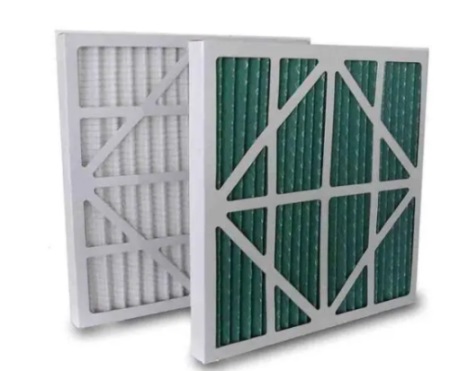
Humidity and temperature fluctuations can also contribute to pressure drop issues.Moisture can occupy adsorption sites within the media,reducing available surface area for target gases and accelerating saturation.Over time,this leads to uneven airflow distribution and localized resistance buildup.
To minimize pressure drop problems,regular monitoring of differential pressure is essential.Engineers should replace Filters based on pressure thresholds rather than fixed time cycles.Additionally,selecting the correct media type and ensuring proper airflow design can significantly improve long-term stability.
In conclusion,pressure drop in an airborne molecular contamination filter system is a natural result of adsorption activity,but it can be effectively controlled through proper design,monitoring,and maintenance strategies.