When discussing high-efficiency air filtration,HEPA Filter material is always at the center of the conversation.For industries such as healthcare,pharmaceuticals,cleanroom manufacturing,and high-end HVAC systems,filtration efficiency is not just a technical specification—it directly impacts product safety,regulatory compliance,and human health.A common question buyers and engineers ask is:Which Hepa Filter material has the highest efficiency,and why?
Understanding filtration efficiency starts with the definition of HEPA itself.HEPA Filter material is designed to remove at least 99.97%of particles with a diameter of 0.3 microns.This particle size is considered the most penetrating particle size(MPPS),meaning it is the hardest to capture.If a material performs well at 0.3 microns,it will perform even better at both larger and smaller particle sizes.However,not all HEPA filter materials perform equally,even if they meet the basic HEPA standard.
The highest efficiency HEPA filter materials are typically made from fine glass microfiber,commonly referred to as fiberglass HEPA filter material.This type of material consists of extremely thin glass fibers arranged in a dense,random structure.The smaller the fiber diameter and the more uniform the fiber distribution,the higher the probability that airborne particles will be captured through diffusion,interception,and inertial impaction.These three filtration mechanisms work together to deliver superior efficiency without relying on electrical charge or chemical treatments.
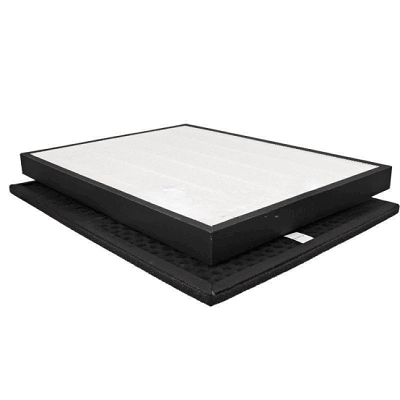
Fiberglass-based HEPA filter material is widely regarded as the most efficient option currently available for true HEPA and even ULPA-grade filtration.In controlled laboratory tests,high-quality fiberglass media consistently achieves stable efficiency above 99.97%,and in some designs,it can reach 99.99%or higher.This stability is especially important in critical environments such as hospitals,pharmaceutical cleanrooms,and laboratories,where performance must remain consistent over time.
In contrast,some synthetic HEPA filter materials rely on electrostatic charging to enhance filtration efficiency.While this approach can initially deliver high efficiency,the performance may decline as the electrostatic charge dissipates due to humidity,airflow,or prolonged use.For buyers who require long-term reliability,especially in medical and industrial applications,this potential drop in efficiency is a significant consideration.This is why medical grade HEPA filter material specifications often favor fiberglass media over purely synthetic alternatives.
Another factor that directly affects efficiency is fiber packing density.Higher efficiency HEPA filter materials use carefully controlled manufacturing processes to ensure optimal fiber spacing.Too dense,and airflow resistance increases dramatically;too loose,and particles pass through.Leading HEPA filter material manufacturers invest heavily in precision production equipment and quality control systems to maintain this balance.From a buyer’s perspective,the manufacturer’s technical capability is just as important as the material itself.
Efficiency is also influenced by the thickness of the HEPA filter material.Thicker media generally allows for more particle capture opportunities as air passes through multiple fiber layers.However,increasing thickness also increases pressure drop,which affects energy consumption and system design.High-efficiency HEPA filter materials strike a balance by using ultra-fine fibers rather than simply increasing thickness.This approach is commonly seen in medical grade HEPA filter material designed for operating rooms and isolation wards.
Environmental conditions must also be considered when evaluating efficiency.Temperature,humidity,and airflow velocity all affect real-world performance.Fiberglass HEPA filter material is inherently resistant to moisture and high temperatures,making it suitable for demanding environments.Synthetic materials may perform well in controlled indoor conditions but can struggle in high-humidity or high-temperature applications.For this reason,industries with strict environmental controls often specify fiberglass HEPA filter material from an experienced HEPA filter material manufacturer.
From a regulatory standpoint,the highest efficiency HEPA filter materials are those that comply with international standards such as EN 1822,ISO 29463,and IEST guidelines.These standards do not simply define a single efficiency number;they require rigorous testing across the entire filter surface to ensure uniform performance.Reputable manufacturers of medical grade HEPA filter material provide full test reports and traceability,which is critical for audits and certifications.
Ultimately,the HEPA filter material with the highest efficiency is not determined by marketing claims but by material composition,fiber technology,and manufacturing precision.Fiberglass-based HEPA filter material remains the industry benchmark for maximum efficiency,long-term stability,and compliance with medical and cleanroom standards.For buyers seeking the highest possible filtration performance,partnering with a qualified HEPA filter material manufacturer that specializes in medical grade HEPA filter material is essential.